That “Perfect Deal” Rental Is Probably Fake: How to Vet a Listing in 15 Minutes (2026)
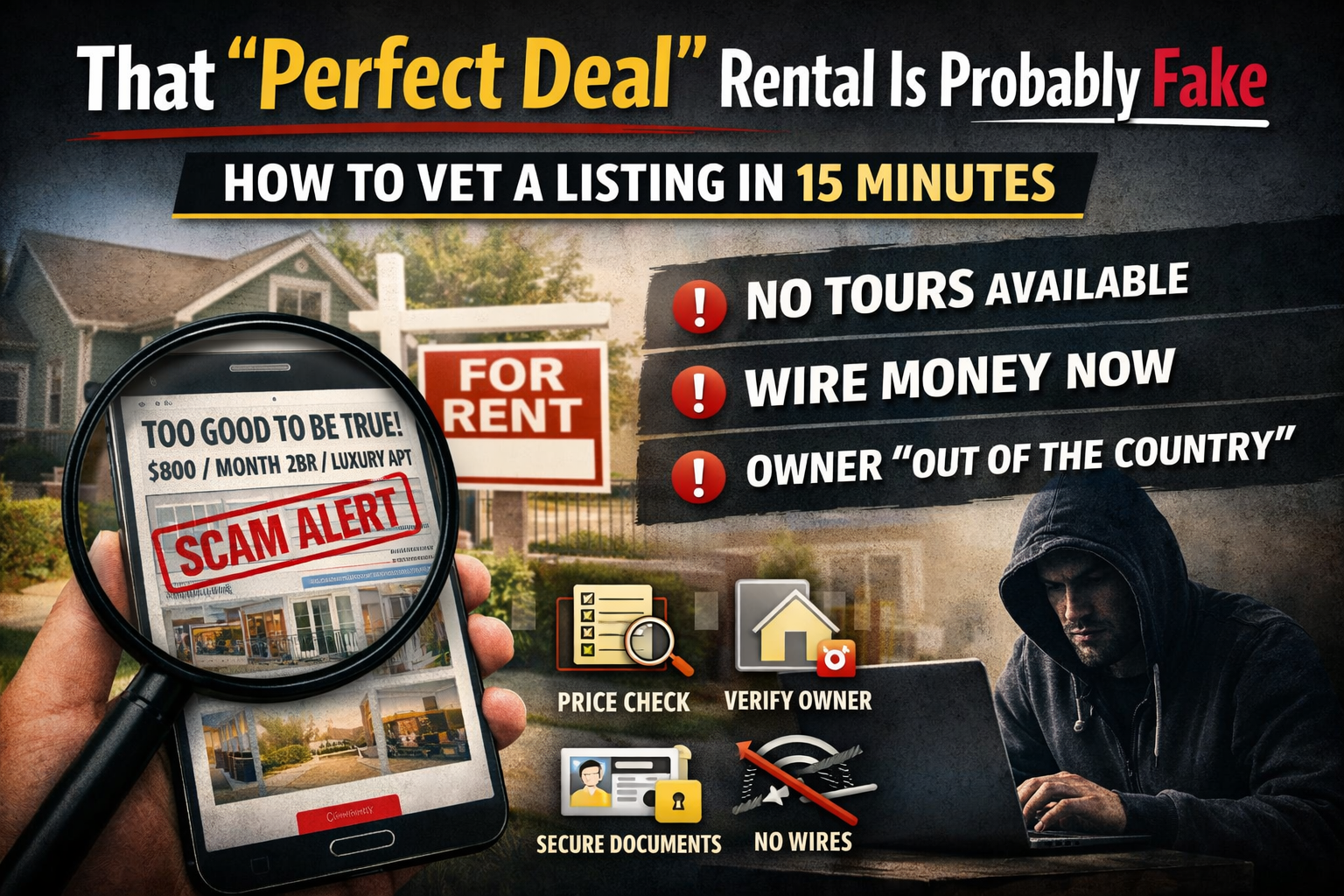
Rental scams don’t target random people — they target motivated renters. If you’re moving fast (especially with past denials, limited credit, or a complicated rental history), scammers know you’re under pressure.
This post gives you a simple, repeatable verification system you can run in 15 minutes — before you apply, before you pay, and before you send sensitive documents.
The Size of the Problem (Real Numbers)
This isn’t a small issue.
Nearly 65,000 rental scams have been reported since 2020, with about $65 million in losses (reported to the Federal Trade Commission).
In 2024, reports tied to these scams included $173,586,820 in losses (reported via FBI Internet Crime Complaint Center data).
And that’s only what gets reported. Real-world losses are likely higher.
How Rental Scams Actually Work (So You Spot Them Faster)
Most rental scams aren’t “clever.” They’re consistent and repetitive.
Common scam patterns
Cloned listing + swapped contact info
A scammer copies a real listing and replaces the contact phone/email with theirs.
Money before access
“To hold it,” “to reserve a tour,” or “to prove you’re serious.”
Credit-check link trap
They push you into a credit-check site that can turn into fees, subscriptions, or data harvesting.
Identity grab
They ask for driver’s license, paystubs, or other sensitive documents early to steal identity info.
If any of those show up, don’t debate. Just verify.
The 15-Minute Verification System
Run these steps every time. It’s boring — that’s the point.
Step 1) Price-check the rent (2 minutes)
If the rent is meaningfully below market, treat it as high risk.
Compare 3–5 similar listings nearby (same beds/baths, same area).
If it’s dramatically cheaper with “immediate move-in” pressure, assume it’s bait until proven otherwise.
Step 2) Duplication test (3 minutes)
Search the full address online.
Look for:
Same property posted with different rent prices
Same photos with different contacts
Property listed as for sale (not for rent)
If the listing appears in multiple places but the contact details don’t match — red flag.
Step 3) Verify ownership or management (5 minutes)
You need a real entity you can verify.
If they claim to be the owner:
Check county property records to see who owns it.
The owner name should match the person/company offering the lease.
If they claim to be property management:
Verify the company:
real website
real office phone number
real business address
Then confirm the person contacting you is actually tied to that company.
Mismatch = move on. No second chances with your money.
Step 4) Verify the showing process (3 minutes)
Legitimate rentals have predictable logistics:
scheduled tours
leasing office process
lockbox/agent showing (with verified identity)
clear application instructions after you view the unit
Scams have excuses:
“I’m out of town”
“Look through the window”
“Pay first, then I’ll send the code”
“I can’t meet, but I’ll email the lease”
Step 5) Payment safety rule (2 minutes)
Hard rule: no irreversible payments to an unverified person.
Avoid:
wire transfers
cryptocurrency
gift cards
“friend & family” payment methods
“just send it and I’ll refund if you don’t like it”
If they won’t accept normal, traceable payment methods through a verified channel, that’s the answer.
Copy/Paste Scripts That Keep You Safe
Text message (before you apply)
“Hey — I’m ready to tour. What’s the official showing process and which company manages the property? I only apply after touring and verifying management.”
Email (verification request)
Subject: Verification before applying — [Property Address]
“Hi — before I submit an application, can you confirm:
the legal owner or management company name,
the official leasing office contact number, and
the tour process?
I’m happy to apply after a verified tour.”
Phone script (60 seconds)
“I’m calling to verify this rental listing for [address].”
“Who is the legal owner/management company listed on the lease?”
“Can I schedule a tour today?”
“What payment methods do you accept for application and move-in fees?”
If they dodge any of those, you don’t proceed.
Red Flags vs Green Flags (Quick Table)
| Signal | What It Usually Means | What You Should Do |
|---|---|---|
| Money requested before a tour | Common deposit or hold-fee scam pattern | Do not send payment until the property is toured and ownership is verified |
| Owner claims to be “out of town” | Pressure tactic used to avoid in-person verification | Insist on a verified showing or move on |
| Rent far below market value | Bait designed to override renter skepticism | Price-check against similar listings in the same area |
| Request for credit score screenshots | Gateway to data harvesting or paid credit-check traps | Never send screenshots; verify landlord identity first |
| Immediate request for ID or paystubs | High risk of identity theft | Only share documents after a verified tour and confirmed management |
| Demand for wire transfer, crypto, or gift cards | Irreversible payment scam | Use only traceable payments through verified entities |
Safe Ways to Share Documents (Without Getting Burned)
Before touring / before verification
Share only basics:
first name
general move-in date
general income range (not full documentation)
questions about requirements
After a verified tour + verified management/owner
Then it’s normal to provide:
paystubs
employment verification
identification
But only through:
an official property portal, or
in-person, or
a verified email domain that matches the real management company
Practical protection moves
Don’t send your “full document packet” to multiple strangers.
Redact anything not needed at that stage.
Keep a record of where you submitted documents.
Soft CTA (Mid-Post)
If you’re tired of playing detective across scam-heavy listings, start with second-chance friendly contacts and verified options first. That’s the point of having a curated path instead of rolling the dice every time.
FAQ (Real Renter Questions)
1) What’s the biggest red flag for a fake rental?
Any request for money before you tour and verify who you’re dealing with.
2) Are rentals on Facebook and Craigslist automatically scams?
Not automatically — but they’re higher-risk environments. Verify harder, not faster.
3) Is it safe to pay a “hold fee”?
Only after:
you toured,
you verified ownership/management,
you have written terms showing where the money goes and if/when it’s refundable.
4) What if they send a lease that looks legit?
Paper can be faked. Verification beats paperwork.
5) When is it okay to send my driver’s license and paystubs?
After you’ve toured and verified the landlord/management via a legitimate channel (portal, verified office contact, or in-person).
6) How do I verify who owns the property?
Check local public property records and confirm the name matches the person/company offering the lease.
7) What payment methods are safest?
Use traceable methods tied to verified entities (official portal, check, card where applicable). Avoid irreversible payments.
8) What if I already paid someone and now it feels wrong?
Stop contact, call your bank/payment provider immediately, and report it to the appropriate consumer and cybercrime channels.
Conclusion: Your Next 3 Moves
Do this every time (10-minute checklist)
✅ Price-check the rent against nearby comps
✅ Search the address for duplicates/mismatched contacts
✅ Verify ownership/management (public records + matching identity)
✅ Tour before you pay
✅ Share documents only after verification
Want the shortcut?
If you want to reduce exposure to scam-heavy dead ends and start with more second-chance friendly options, here’s the SCL resource:
https://www.secondchancelist.com/shop/p/second-chance-master-list
Light disclaimer: Housing rules, screening standards, and fee limits vary by state and city. This is general educational information, not legal advice.